|
Due to their economic status and local telecommunications
infrastructure NGOs in developing countries generally have limited access to
technology. For the majority,
computers are shared among multiple users and internet access is a luxury
enjoyed by a small percentage of NGOs.
The use of technology by NGOs can be estimated by analyzing
the level of technology use in the community or country where the NGO is based. The
following provides a summary of technology usage per regions in developing
countries:
EASTERN
EUROPE
The
following graphs provide an overview of technology use by NGOs in Eastern
European countries.
Availability of Modern
Communication / Information means for NGOs in Moldova, Ukraine, Russia,
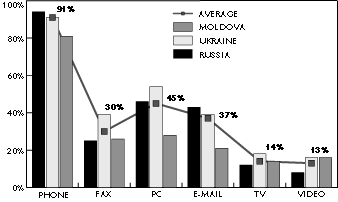
Availability
of Modern Communication / Information Means for NGOs (Average)
LATIN AMERICA
Compared to other developing countries, Latin America is
experiencing the strongest growth in internet use. Jupiter Communications predicts that the rate of growth in
Internet penetration will surpass that of Asia, Europe, and the United States
over the next several years. There are currently 13.3 million people online in
Latin America, less than 3 percent of the population; however, this represents a
136 percent increase from 1998. By
2005, Jupiter Communications expects 66.6 million Latin Americans to be online.
Internet penetration remains, however, concentrated in the most developed
Latin American countries, namely Brazil, Mexico and Argentina.
Latin American growth in personal computer penetration and
Internet usage is said to be the world’s fastest. The total number of users is
projected to nearly triple, from between 12 million and 16 million in 2000 to
43.4 million in 2003, according to the Internet research firm Jupiter
Communications.
Yet the
main problem one is faced with when surfing the internet is the one of high
costs. In the USA, unlimited access to the web is charged with only 20 US$ per
month; in Latin America, however, the costs are between 12.75 US$ in Peru and
260 US$ in Cuba. A business in Miami pays approximately 60 US$ per month for a
permanent line, whereas in Venezuela, the costs add up to 1,500 US$. Moreover,
one has to wait for months to be connected, or one must bribe one’s way to the
internet. As a result, 80 % of the Latin American businesses prefer to
communicate via paper and fax.
Table 3:
Internet access and costs in Latin America in 1999
|
Country
|
Date
|
Number of users*
|
% of population
online
|
Average monthly
costs of Internet in US$
|
GNP/head in US$
per year
|
|
Argentina
|
April
1999
|
586,000
|
1.70
|
54 $
|
8.498
|
|
Belize
|
|
|
|
20 $
|
5.623
|
|
Bolivia
|
October 1997
|
8,000
|
0.11
|
|
2.617
|
|
Brazil
|
July 1999
|
2.7
million
|
1.70
|
26.96
$
|
5.928
|
|
Chile
|
April 1999
|
150,000
|
1.05
|
40.27 $
|
9.930
|
|
Costa Rica
|
April
1999
|
30,000
|
0.89
|
40
$
|
5.969
|
|
Dominican
Republic
|
April 1999
|
25,000
|
0.32
|
|
3.923
|
|
Ecuador
|
October
1997
|
5,000
|
0.04
|
45 $
|
4.602
|
|
Haiti
|
July
1998
|
2,000
|
0.27
|
|
917
|
|
Honduras
|
|
|
|
39.29 $
|
1.977
|
|
Colombia
|
April
1999
|
350,000
|
0.95
|
35.56 $
|
6.347
|
|
Cuba
|
May 1999
|
22,000**
|
0.20
|
260 $
|
3.100
|
|
Mexico
|
April
1999
|
600,000
|
0.65
|
26.10 $
|
6.769
|
|
Nicaragua
|
April 1999
|
10.000
|
0.23
|
30
$
|
1.837
|
|
Paraguay
|
October 1997
|
1,000
|
0.02
|
|
3.583
|
|
Peru
|
April
1999
|
20,000
|
0.08
|
12.75 $
|
3.940
|
|
Puerto Rico
|
|
|
|
29 $
|
|
|
Uruguay
|
April
1999
|
90,000
|
2.83
|
29.95 $
|
6.854
|
|
Venezuela
|
April 1999
|
380,000
|
1.75
|
54.35
$
|
8.090
|
|
Latin
America
|
July 1999
|
5
million
|
1.12
|
36.23
$
|
|
©
Macondo 1999
Commercial ISPs;
** state-owned ISP CENIAI.
Sources: ITU/Siemens, IABIN, News.com, IDC, Handelsblatt, Cyberatlas, reuters,
Delatrade, UNDP 1998)
A
report by Telecommons Development Group analyzed Internet use by NGOs in Uganda.
(Appendix foot) By looking at internet use by NGOs in Uganda conclusions can be
drawn for other African countries. The typical NGO (70%) in Uganda has only one
computer with Internet connectivity within their offices; this presents
challenges and restrictions in terms of the frequency with which the Internet
can be accessed. A mere 5% of the NGOs with field sites reported that those
sites were connected with either email or Internet; 33% reported having field
sites without any means of direct voice or data transmission systems. The
majority of NGOs with World Wide Web service reported using the systems for
accessing and researching documents relevant to their work, but 32% of those
organizations reported that they either seldom or never used the Internet that
was available to them. Most NGOs reported that they used the email to
communicate with international partners; use of the Internet for local
communications is low. Respondents reported that email was a very convenient
mode of communications, effective in transmitting documents at lower costs than
other technologies. Obtaining access to the computers, and the sending and
receiving of attached documents proved the most problematic issues for
respondents; the latter issue raises questions about the quality of training
these organizations are receiving from their ISPs. The paper concludes with
lessons learned from the research, and recommends areas for more detailed study.
(McConnel)
|