 |
Contact Us |
Fast Facts |
Search |
|
|
Contact Us |
Fast Facts |
Search |
|
|
|
Board of Directors Executive Summary Mission Partners Who we Help |
|
The InterConnection
website has been updated
About Us: Internet Statistics |
 |
|
|
|
INFORMATION TECHNOLOGY IN DEVELOPING COUNTRIES Nelson Mandela once said, "If we cannot ensure that this global revolution creates a world-wide information society in which everyone has a stake and can play a part, then it will not have been a revolution at all." We know that not everyone has the skills and resources to be involved in this technologic revolution. For example, Less than 1% of people in South Asia are online, even though it is home to one-fifth of the world’s population. (UN human development report, 1999). Forty-one percent of North Americans have internet access compared to 3% of those in Latin America and 2% in Asia/Pacific (Jupiter Communications, 2000). While the Internet is creating new ways of doing business and communicating, it unintentionally creates a disparity between the haves and the have-nots, perhaps faster and more significantly than any other movement in history. InterConnection’s primary goal is to provide groups with the ability to join the Internet revolution by "getting online". Barriers
to internet access include: ·
Telecommunication infrastructure The
following statistics illustrate the technology divide between developed
and developing countries:
·
30 percent of the US population is
online compared with an average of 0.6 percent in developing countries. ·
UN Human Development Report,
industrialized countries, with only 15% of the world’s population, are
home to 88% of all Internet users. Less than 1% of people in South Asia
are online even though it is home to one-fifth of the world’s population. November
1, 1999 ·
More than 80% of the world’s
people have never heard a dial tone, let alone sent an email or downloaded
information from the web. BBC
News 2001 ·
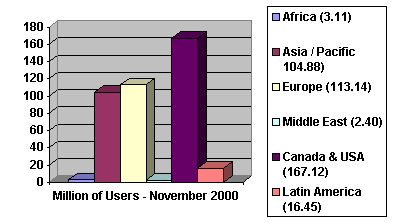
Nearly 90 percent of all Internet
users are in industrialized countries, with the United States and Canada
alone accounting for 57 percent of the total. In contrast, Internet users
in Africa and the Middle East, together account for only 1 percent of the
global Internet users. International
Labour Organization, 2001 ·
The US and Canada alone account
for 57 per cent of the world’s Internet users whereas Africa and the
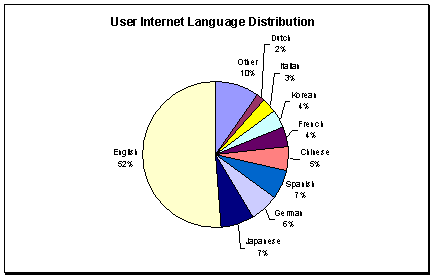
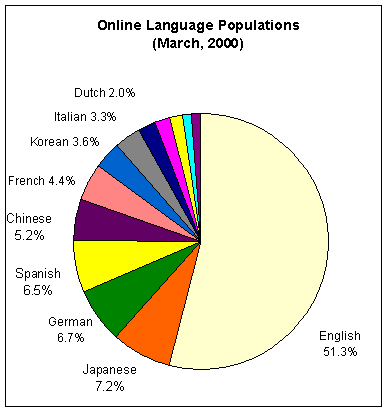
Middle East together account for only 1 per cent. It is estimated that
approximately 75 per cent of all Internet information is produced in just
one language: English. International Labour Organization, 2001 ·
The most striking digital gender
divide relates to Internet use, with women in the minority of users in
both developed and developing countries. For example, only 38 percent of
Internet users in Latin America are women, while in the European Union the
figure is 25 percent, in Russia 19 percent, in Japan 18 percent, and in
the Middle East 4 percent.
·
Nearly all the world’s information
and communication technologies (ICT) is produced by approximately 15 per
cent of the population (living mostly in industrialized countries). Only
about one-half the world’s population even has access to the electricity,
phone lines and other infrastructure necessary to enable them to adapt
these technologies in production and consumption. That leaves most of the
world’s population at a significant disadvantage and at least one-third of
the world’s population "technologically disconnected." International
Labour Organization, 2001 · Africa’s entire population of 739 million people has fewer than 14 million telephones. International
Labour Organization, 2001 ·
The estimated online population in
Africa is 1.15 million. The
majority of internet users in Africa are from South Africa, with just over
a million users. EMarketer,
2000
Source: Global Reach, 2000
Estimating the worldwide Internet population is, at this point in time, an inexact science. The information that is displayed on this map is compiled from a number of sources worldwide, including CommerceNet Global Partners and NUA.
The number of Internet users in Latin America will reach 29.6 million by the end of 2003, according to IDC (www.idc.com). This is more than double the projected figure for the end of 2000, which is 13.3 million users. IDC’s aggressively optimistic predictions are based on the increasing availability and popularity of free ISP services in the region. Other factors include lower PC costs in Mexico lower Net access rates in Brazil and lower call charges in Chile and Argentina. The biggest Latin American market in 1999 was Brazil, with 41 percent of total users in the region. Mexico had 21 percent of users, Argentina had 10 percent and Chile and Colombia had 6 percent each. Venezuela had 5 percent and the remaining 12 percent of users were from the other countries in the region. Source: NUA Internet Surveys, Mar 21 2000: http://www.nua.ie
source: Global Reach http://www.glreach.com/globstats/index.php3 Computer Industry Almanac reports an expected,
They also report by 2002, the US will have 1/3 of total Internet users and will decline to 27% at year-end 2005. (Nov. 1999) According to Computer Economics, an expected 213 million online users worldwide by 2001 and by 2005, the number is expected to increase to 350 million. (Jan. 1999) NUA reports that 60% of the world online population will be outside the US by 2003. (Nov. 1999) Source: CommerceNet, 1999 http://www.commerce.net |
|||||||||||||||||||||||||||||||||||||||||||||||||||||||||||||||||||||||||||||||||||||||||||||||||||||||||||||||||||||||||||||
InterConnection
[email protected]
Technology assistance for non-profit organizations in developing countries.

About Us | Services |
Organizations |
Volunteer | Resources |
Support