|
1. The Peanut Basin
(nearly 30% of the nation’s land area) accounts for around three-quarters
of Senegal’s grain and peanut production.
 Highly
populated and continuously cultivated, the most exploited zones
are seeing the people become impoverished and the land degraded.
The model of exploitation put in place over many dozens of years
is based on a culture principally characterized by mechanization
and fertilization: peanuts cultivated in rotation with millet have
not resisted climatic changes. In the 1980’s, the rigors of the
program of structural adjustment, paired with a growing demographic
pressure, definitely compromised the fragile earlier equilibrium.
In spite of numerous research and projects carried out in this zone
over the course of the last decades, few solutions were found to
arrest the degradation of the environment and thus the urban and
rural impoverishment already underway. Highly
populated and continuously cultivated, the most exploited zones
are seeing the people become impoverished and the land degraded.
The model of exploitation put in place over many dozens of years
is based on a culture principally characterized by mechanization
and fertilization: peanuts cultivated in rotation with millet have
not resisted climatic changes. In the 1980’s, the rigors of the
program of structural adjustment, paired with a growing demographic
pressure, definitely compromised the fragile earlier equilibrium.
In spite of numerous research and projects carried out in this zone
over the course of the last decades, few solutions were found to
arrest the degradation of the environment and thus the urban and
rural impoverishment already underway.
In view of this situation and the account now taken of the urgency
of the problems in certain parts of the Basin, alternative
solutions must be researched and put in place. The methodology
of the approach and analysis to adopt must be different from those
that have presided over the preceding choice of actions and projects.
An essential place must be accorded:
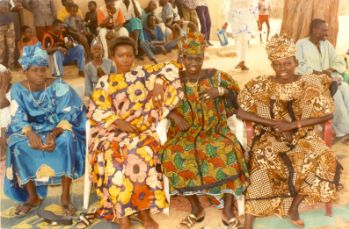 to the wisdom of the peasant farmers;
- to the peasant organizations and to their participation
together in the process of development of new proposals (in choice,
decision-making, implementation, and management);
- to the natural milieu considered as a whole,
with heritage and national resource on the one hand, and utility
of production for actions integrating agriculture, forests and
pasture on the other;
- to multiple and integrated paths of activities
and means of production rather than a monoculture of peanut production:
the multi-cultivation of staple foods (millet, corn, sorghum,
peanuts, niébe, manioc, fresh vegetables), raising animals for
market, the cultivation of trees, as well as the transformation
to and establishment of fair market value for production at the
rural level.
^top^
2. The Problematics and Goals of the Peanut
Basin are correctly placed in a national context. However,
certain of the goals are particularly urgent locally as well:
-
 density
of the rising population; density
of the rising population;
- the fragile and endangered natural environment
and, in some zones, severe degradation already underway;
- the extension of cultivated lands to the detriment
of pasture and forested areas;
- stagnation of production;
- declining fertility of the soil;
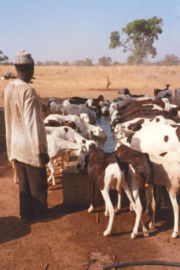
- stagnation of animal husbandry;
- the lack of valorization of rural production
and the importance of diversification of rural activities;
- weakness of agricultural revenue which hastens
the exodus from rural areas (now moving from seasonal to extended
duration);
- slow modernization of indigenous crafts and
weak development of local industries, which could, if developed,
increase employment and produce equipment and material needed
to improve the quality of life in rural areas;
- the approach of development up until very recently
has been technical, dictated by outsiders to the rural areas,
oriented towards a single cash crop predominantly for export,
i.e., peanuts, rather than a healthy-for-the land diversification,
and has principally focused on men while ignoring the needs of
women.
^top^
3. A viable strategy of rural development
in the Peanut Basin must take account of three indivisible
dimensions:
- the socio-cultural dimension which takes into consideration
the different subgroups of the population, including ethnic groups,
men, women, and youth, their traditional knowledge and present
milieu;
- the environmental dimension which must be integrated into all
technical and economic choices to the end of reconciling the protection
and regeneration of the environment with economic development;
and
- the economic dimension which must take account, at the same
time, of the potentiality and limitations of the milieu, the factors
of production and the possibilities for transformation and valorization
of products and conditions of the marketplace for the benefit
of local producers and the sustenance of rural communities.
^top^
4. Taking account of these three dimensions
permits reinforcement of responsibility for the rural world by the
national government and all stakeholders and of instituting integrated
programs which take account of the needs of the rural population.
The reason for the proposed programs is justified by:
- the growing imbalance which exists between the weak productivity
for most current systems of production and the needs of a population
which never ceases to grow; and
- a farmer’s dynamic which is characterized
recently by an upsurge in village organization prepared to dialogue
with all who intervene in the local scene and to participate in
a reflection on alternative solutions toward the goal of sustainable
development.
|